Teletherapy has become one of the most accessible ways to receive support. Often teletherapy is chosen for convenience; however, several unique advantages are particularly ideal for professionals.
As a professional and high-achiever, you realize that life doesn’t slow down when things get difficult.
You know all too well that demands and responsibilities continue to pile up.
Relationships also get complicated.
As a result, stress continues to build quietly in the background until it starts affecting sleep, focus, mood, and overall well-being.
Teleptherapy is ideal for high-achievers, because it removes obstacles that interfere with seeking support. Instead of rearranging your day to drive across town, and sit in a waiting room, support is provided through secure video or phone sessions from your home, office, or any stationary and quiet-private space.
Why Achievement, Performance, and Success Don’t Protect You from Chronic Exhaustion
In a world of high-stakes leadership, strength is the dominant currency of influence. High-achievers and high-octane performers often serve as the anchors of their organizations. They are the reliable ones. The ones that others instinctively turn to when complexity peaks and the path forward is obscured.
Often they are expected to provide strength and clarity. As a result of their dedication, drive and achievement they are often considered to be invulnerable. This perceived invulnerability creates a dangerous paradox: the more reliable and productive you are, the more you are expected to be available.
The Paradox of Achievement, Performance and Success
Years of sustained performance, achievement and reliability eventually takes a toll. This level of functioning quietly progress from a professional asset into a constant, unyielding expectation of 24/7 availability and strength.
Despite typically operating at a high-octane tempo – sustaining this pace for extended periods of time is a breeding ground for a specific, clinical level of exhaustion. This level of exhaustion becomes chronic. It’s a level of exhaustion that a simple weekend away or a few extra hours of sleep cannot touch.
When Being Capable Turns Into Always Being “On”
Your sympathetic nervous system is designed for short bursts of intensity, not a permanent on switch. When the boundaries between work and home blur, your nervous system never fully resets.
As a result of extended periods of sustained pressure, you experience a complex physical state of sympathetic nervous system overload. When this overload is not adequately addressed, it leads to depletion. This depletion impacts the valuable core traits that fuel your success and drive – tenacity, responsibility, and vision. These traits then become the weights that pull you under.
Rather than acting as a shield, your success acts as a trigger for deeper fatigue, because the stakes of failure or stepping back involve much larger consequences for yourself and others.
This article explores the mechanics of exhaustion and provides a sequence for restoration: discharge, recharge, and purpose.
Part I: The Anatomy of Executive Exhaustion
For the high-achiever, exhaustion is not a lack of character or a sudden loss of grit. It is the result of several compounding factors that operate simultaneously.

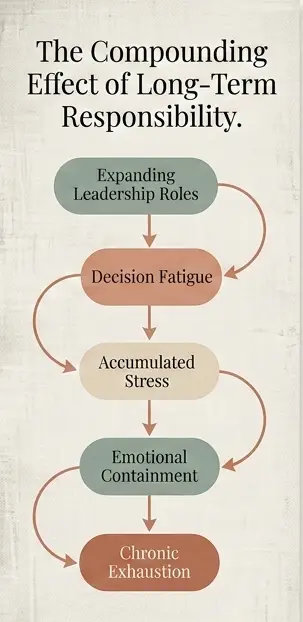
As leadership roles expand, so do the stakes of every decision. This creates a specific type of fatigue that traditional rest cannot touch.
1. The Compounding Effect of Long-Term Responsibility
Leadership is not a static state; it is a cumulative weight. As your career progresses, the scale of your decisions grow, impacting more lives, larger budgets, and broader institutional missions.
-
- The Identity Trap: Professional self-worth often becomes inextricably tied to your capability to solve the “unsolvable”. When your identity is entirely performance-based, you start seeing yourself as a high-output machine and lose the ability to rest – because resting feels like failure.
-
- Sustained Pressure – Decision Fatigue: Every choice you make, from high-level strategy to minor personnel issues, consumes a finite amount of cognitive energy. By midday, many leaders are operating on fumes, leading to “analysis paralysis” or impulsive choices just to clear the desk. Unlike an acute crisis that ends, high-level leadership is a marathon of sprints. Years of maintaining this pace without a significant “off-ramp” leads to a depletion of your foundational reserves.
-
- Life Stage Convergence: Often, the peak of professional demand coincides with increasing family responsibilities – raising toddlers and teenagers, caring for aging parents, or managing complex households.
-
- Reliable Burden: Being the “reliable one” for everyone else means you become a single point of failure. If you aren’t functioning, the system feels as though it will collapse. This creates a state of chronic hyper-arousal, resulting in your mind remaining “at the desk” even when your body is at home.
2. Cognitive Overdrive: The Mind at Night
While your team sees a composed exterior, the internal reality is often one of cognitive overdrive. This is the inability of the brain to downshift from high-stakes problem solving to a state of rest.
You may have noticed that your mind does not go off when the office lights do.
In fact, at the end of the day although you are physically exhausted, when you lay your head on the pillow – your mind seems to go into overdrive.
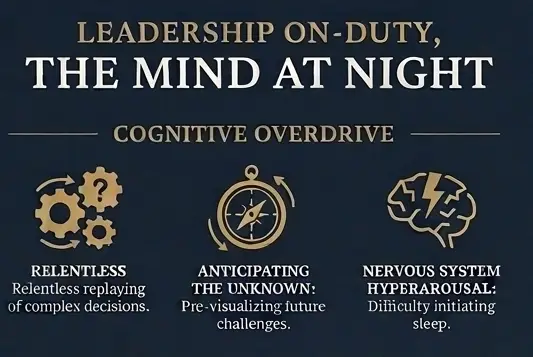
- Relentless Replaying: The mind compulsively loops through the day’s interactions, scrutinizing decisions and searching for missed variables. This mental rehearsal prevents the brain from entering the deep delta-wave sleep required for true recovery.
- Anticipating the Unknown: You are constantly pre-visualizing future challenges, effectively living in a triaging state where you are solving tomorrow’s crises today.
- Nervous System Hyperarousal: This mental activity keeps the body in a state of alert, making it difficult to initiate or maintain restorative sleep. You may be physically in bed, but your nervous system is still in the boardroom.
3. The Cost of Duty: Personal Isolation
The reliable burden creates a unique form of isolation. Because you are the person everyone else relies on, there are few spaces where you feel permitted to be the one who is tired.
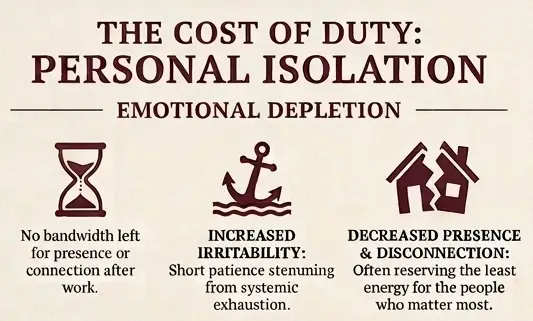
- Emotional Containment: Leaders often feel they must maintain a composed exterior at all times to protect the morale of their teams and the stability of their families. This constant suppression of stress is, in itself, exhausting.
- The Bandwidth Deficit: By the time you finish the workday, your emotional fuel tank is empty. You return home with no bandwidth left for the people you actually do all this work for in the first place. This often manifests as increased irritability or a short fuse with those you love most.
Part II: Internal Friction
For the high-achieving professional and high-octane performer, the most grueling form of exhaustion isn’t physical – it is the moral and psychological fatigue that arises when your daily professional actions begin to drift away from your internal compass.
This value conflict is often the invisible driver behind chronic burnout, creating a state of internal friction that no amount of traditional rest can resolve.
When Demands Conflict with Values and Integrity
In elite and high-pressure environments, success is often measured by metrics that favor efficiency, bottom-line growth, and rapid problem-solving. While necessary for business, these can frequently clash with personal integrity. When productivity is prioritized at the detriment of the workforce or consumers – outcomes can be catastrophic.
Leaders who manage these variables tend to experience tension between ensuring company growth and simultaneously maintaining care of the companies most important asset – their workforce. This often places leaders in compromising situations to enforce decisions that challenge their values and integrity.

When your environment stops aligning with your “true north,” internal friction grows. This friction is often discouraged from being discussed openly, leading to a profound sense of value conflict.
-
- Enforcing the Disagreeable: High-integrity professionals are frequently placed in the precarious position of enforcing corporate policies or making executive decisions they disagree with that challenge their values. This creates a state of cognitive dissonance – the mental discomfort of holding two conflicting beliefs or acting in a way that contradicts your values. In extreme situations, when required to act contrary to your morals and values can lead to moral injury.
-
- The Productivity Paradox: You may find yourself prioritizing productivity in ways that challenge your commitment to excellence or your concern for your team’s well-being. When reliable burden forces you to sacrifice quality for speed, or human connection for output, a slow-burning resentment begins to build.
-
- The Responsibility Standard: The very traits that facilitated your ascent – conscientiousness, a desire for excellence, and deep-seated integrity – are the same traits that make you vulnerable. Because you care deeply about doing things the right way, you carry a greater internal standard of responsibility. When the environment stops aligning with those values, you don’t just feel stressed; you feel a sense of personal compromise.
Those who care deeply about doing things well often carry a greater internal standard of responsibility. The very traits that helped you succeed – integrity, conscientiousness, and a desire for excellence – are the same traits that make you more vulnerable to chronic internal pressure when your environment stops aligning with your values.
Why High-Functioning Adults & Professionals Delay Support
Despite the mounting internal pressure, high-functioning adults & professionals are statistically the least likely to seek early intervention.
Unfortunately, the same drive that makes you successful creates a set of psychological barriers to seeking help.
The Illusion of Capability
There is a pervasive belief among elite high-achieving adults & professionals that “I should be able to handle this myself.” You have spent a career solving complex crises for others; admitting that you cannot solve your own internal exhaustion feels, too much, like an admission of failure.
-
- Fear of Appearing Incapable: In high-stakes environments, vulnerability is often misconstrued as weakness. There is a legitimate fear that seeking mental health support could impact career trajectory or professional standing.
-
- Confidentiality Concerns: For high-profile leaders, the need for absolute discretion is paramount. The risk of personal struggles becoming public or known within the organization is a significant deterrent.
-
- Time Constraints: When you are already operating with a bandwidth deficit, the idea of adding one more thing – even therapy – feels like one more burden.
Strategic Decision-Making vs. Failure
Seeking support is a strategic decision, not a failure. It is the act of a high-achiever recognizing that to sustain long-term success, you must protect your most valuable asset: your ability to function with clarity and precision.
Just as an elite athlete utilizes a team of specialists to maintain peak physical performance, a high-level professional must utilize specialized support to maintain peak cognitive and emotional performance.
Part III: The Restoration Sequence
Pivoting from depletion back to strength and fortitude is an active, tactical process using a phased sequence of discharge, recharge, and purpose designed to address the nervous system directly.
Phase 1. Stress and Physiological Discharge: Rhythmic Endurance
High-stakes leadership keeps the bodies sympathetic nervous system in a hyperarousal state of fight or flight.
You cannot think your way out of a physiological state. You must manually override this system through physical exertion. If your nervous system is stuck in an overdrive “fight or flight” state, you must use the body to signal safety to the brain. The first step is not rest, but discharge.

Neurotransmitter Reset: Intense physical activity – trail running, cycling, or heavy resistance training – stimulates the release of endorphins, dopamine, and serotonin. This chemical flood actively counteracts the high cortisol levels that have accumulated during the work day and periods of high-stakes stress.
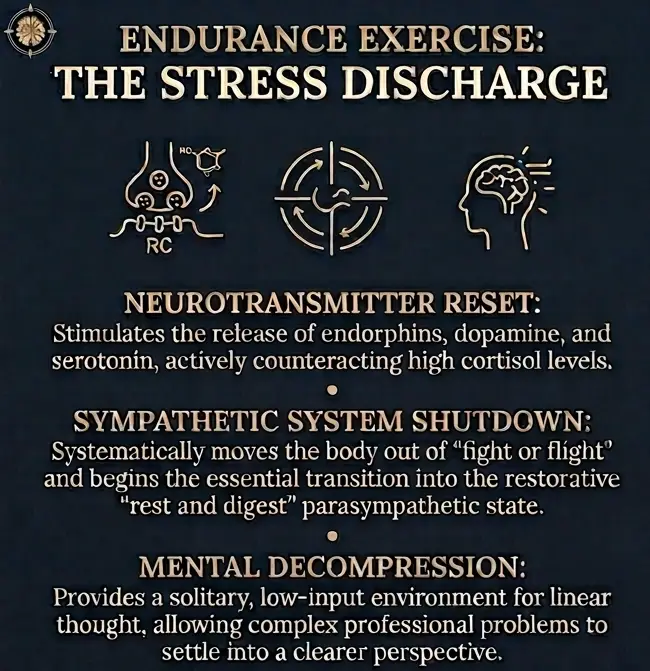
- Sympathetic System Shutdown: Rhythmic, repetitive movement serves as a manual override for the sympathetic nervous system. It forces the body to move out of hyperarousal and initiates the transition into the restorative, rest and digest parasympathetic state.
- Mental Decompression: In a world of high-input (emails, meetings, calls, text, and streaming media), endurance exercise provides a solitary, low-input environment for linear thought, allowing complex problems to settle into a clearer perspective.
Phase 2. Vital Recharge: Stillness and Grounding
Once the stress is discharged, the hyperarousal or noise of the sympathetic nervous system is decreased. You then can transition into the rest and digest – restorative signal – of the parasympathetic nervous system. This phase focuses on intentional pauses and movement designed to recharge and reclaim mental fortitude.
Once the stress is discharged, you can move into Physical Restoration. This is “Vital Recharge” – an intentional pause that is not optional, but essential for returning to focus.

Analog Start
Beginning the day with grounding, reflection, and stillness – before checking a screen – protects your first thoughts from being hijacked by other priorities. This helps build the internal strength and fortitude required for high-stakes leadership.
Physical Rest in Nature
Whether it is a brief walk, or sitting in a quiet clearing – nature provides a physical reset. Being in nature is an essential tool for returning to clarity. It allows the mind to find a zero point away from digital inputs and blurred boundaries.
The Non-Optional Pause
Stillness is not a luxury for the professional; it is a tactical necessity. Without these resets, the “mental load” becomes a cumulative weight that eventually leads to structural failure.


Phase 3: Connecting to Purpose (The “Why”)
The final stage of the restoration sequence is the most critical: remembering who you are outside of your professional utility. The ultimate goal is not just to work more efficiently, but to reclaim your life.
It’s perfectly understandable that you enjoy your career, but keep in mind – you work to live, not live to work.
Presence over Provision: Reclaiming Your Bandwidth
It is a common trap for high-achievers to justify their exhaustion by focusing on what they provide for their families. You may tell yourself, “I am doing this for them,” while you are physically present at the dinner table but mentally 1,000 miles away in the office.
-
- Values Alignment: True strength and fortitude is found when your professional demands no longer conflict with your core self. This requires a radical realignment – moving away from “blurred boundaries” and toward a life where success is measured by your ability to be fully physically and emotionally present with those who matter most.
-
- The Reality of Connection: The people who matter most to you would almost always prefer you to be fully present over your additional provision.
-
- Emotional Availability: Chronic exhaustion robs you of your ability to be emotionally available. When your bandwidth is consumed by Cognitive Overdrive,” you lack the patience, empathy, and joy required to nurture your most important relationships.

Values Alignment: The Foundation of Strength
True strength and fortitude are not found in the ability to endure endless suffering; they are found when your professional demands no longer conflict with your core values.
-
- Radical Realignment: This requires moving away from blurred boundaries where work bleeds into every waking hour. It means moving toward a life where success is measured by your ability to be fully present with those you love.
-
- Professional Dignity: Setting boundaries is the foundation of long-term leadership. It demonstrates a level of self-respect and structural resilience that actually inspires those you lead.
Recovering from chronic exhaustion requires a fundamental shift in how you view your role. You must find alignment between professional demands and your personal well-being.
How Teletherapy Restores Alignment
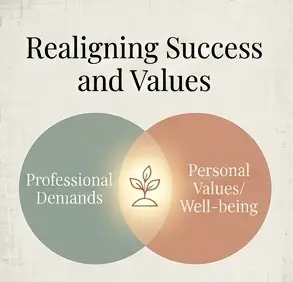
Teletherapy offers a confidential, flexible environment for high-achieving adults & professionals to examine patterns of blurred boundaries and restore alignment between professional success, personal values, and overall well-being. It allows you to address the pressure before it escalates to a breaking point.
Seeking support is a strategic decision, not a failure. It is the act of a high-achiever recognizing that to sustain long-term success, you must protect your most valuable asset: your ability to function with clarity and precision.
Therapy Focuses On:
-
- Reducing Chronic Mental Load: Offloading the always on state.
-
- Restoring Sleep: Addressing the cognitive overdrive that keeps you awake.
-
- Clarifying Boundaries: Learning how to be reliable without being responsible for everything.
-
- Resolving Value Conflicts: Finding alignment between your career and your core self.
Conclusion: A Call to Reflection
Exhaustion is a signal that your current system of operating has reached its limit. It is not a failure; it is a diagnostic. If you find yourself in a state of reliable burden – where you are the one everyone relies on at the cost of your own health – it is time to reflect.
-
- Audit Your Bandwidth: Is your current pace sustainable for the “Why” behind your work?
-
- Identify the Leak: Where has your “responsibility” expanded to include burdens that are not actually yours to carry?
-
- Set the First Boundary: What is one small boundary you can set this week to reclaim even a small piece of your mental energy?
Transitioning from being always on to being truly present is the highest level of achievement. Reclaim your clarity, your peace, and your life.
Through reflecting and implementing small, actionable steps of physical discharge, intentional recharge, and reconnecting to your core purpose, you can move from a state of “Chronic Exhaustion“ back to Integrated Strength and Fortitude.
If you recognize yourself in these descriptions, understand that the path forward is not doing more, but doing differently.

Tricha Weeks is a Clinical Psychologist and founder of Grace Endures Psychotherapy, where she provides teletherapy for high-achieving adults navigating anxiety, chronic stress, burnout, sleep difficulties, trauma, life transitions, misaligned values, and relationship challenges. Her work focuses on providing support as her clients prioritize their values to create meaningful change that extends beyond symptom relief. Dr. Weeks focus is reinforced by feedback, observation, and experience about the importance of realigning how you live and lead so success is more sustainable – not depleting. Learn more at graceendures.com